Why We Created One Touch

.webp)

.webp)
.webp)
When you’re a child, you watch the ball.
It’s almost impossible not to.
You follow it everywhere, from one side of the pitch to the other, convinced that everything important happens wherever it happens to be. Goals, dribbles, tackles, celebrations… football seems to revolve around a single object that twenty-two players spend ninety minutes chasing.
Then, little by little, something changes.
You begin to notice the striker making a run that nobody rewards. You see the defender who steps forward at exactly the right moment to catch an opponent offside. You realise that a midfielder slows the game down on purpose, not because he has no solution, but because waiting two more seconds will create a better one. You stop watching the ball all the time and start watching everything happening around it.
Without really noticing, you’ve started to understand football differently.
And once that happens, there is no going back.
Football has never really been about the ball.
That might sound strange at first.
After all, football is played with a ball. Every statistic revolves around it. Every highlight begins and ends with it.
Yet the moments that stay with us rarely start when a player touches the ball. They begin long before.
A striker pulls a defender out of position without ever receiving a pass. A full-back overlaps simply to create space for someone else. A goalkeeper takes two extra steps forward because he has already read the danger developing. A captain asks his team to slow the tempo, not because they are under pressure, but because he knows the right moment has not arrived yet.
Football is a game of movements before actions.
Of decisions before execution.
Of patience before brilliance.
The goal is only the final chapter of a story that often started thirty seconds earlier.
That is the football we fell in love with.
Looking for that feeling
Like millions of football fans, we grew up playing football games.
Some became part of our childhood. Others stayed with us for years. We spent countless evenings competing with friends, building teams, discovering players and recreating famous matches. Those games gave us unforgettable memories, and they played an important role in our love for both football and video games.
But over time, one question kept coming back.
Why did we never feel exactly what we felt while watching a real match?
The players looked real.
The stadiums looked real.
The atmosphere sounded real.
Everything looked like football.
Yet something was missing.
Not because those games were bad.
Simply because they were trying to recreate football from the perspective of the player on the pitch.
We wanted to explore another perspective.
The one from the bench.
The one from the stands.
The one that asks not “Can I score this goal?” but “What decision gives me the best chance to score thirty seconds from now?”
That question never really left us.
Eventually, it became One Touch.
Building a game around decisions
When we first started working on One Touch, we didn’t begin by designing cards.
We didn’t begin with players.
We didn’t even begin with football.
We began with questions.
How do you make timing matter?
How do you make patience rewarding?
How do you recreate the feeling that a match can change because of one intelligent decision rather than one impossible piece of skill?
How do you turn football intelligence into gameplay?
Those questions guided every mechanic we designed.
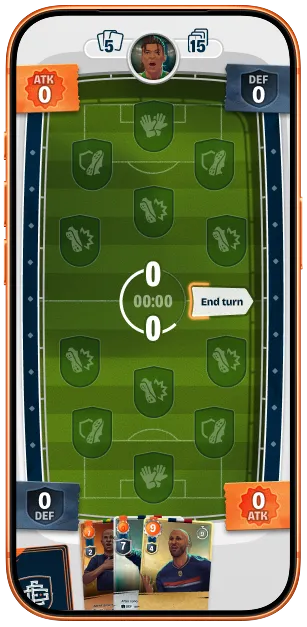
The match clock became a resource because time changes the way football is played.
Fatigue became a core mechanic because no player can sprint at full intensity for ninety minutes.
Deckbuilding became a matter of balance because great coaches never select the twenty best players they have. They select the twenty players who fit the same idea of football.
Even our cards were never designed to represent statistics alone. Every Player, every Staff member and every Power card exists to embody a football philosophy, a tactical idea or a personality that could influence the rhythm of a match.
In One Touch, every mechanic exists because of football.
Never the other way around.
Every card tells a football story
One of the first decisions we made was also one of the most important.
We didn’t want cards to feel like numbers.
We wanted them to feel like people.
Some are inspired by football legends.
Others are entirely original characters created for the One Touch universe.
Yet they all follow the same principle.
Every player has a story.
Every coach has a philosophy.
Every card has an identity.
Because football supporters rarely fall in love with statistics.
They fall in love with personalities.
With styles of play.
With unforgettable moments.
With players who somehow make the game feel different whenever they step onto the pitch.
That is exactly what we want our cards to become.
Not stronger.
More memorable.
Rediscover Football
People often ask us whether One Touch is a football game or a card game.
The truth is that we never really started from either.
We started from football itself.
From the emotions that make us stay until the final whistle.
From the conversations that continue long after the match has finished.
From the tactical debates, the unforgettable players, the impossible comebacks and the tiny decisions that end up changing everything.
One Touch is simply our way of celebrating those moments.
Not by trying to replace football.
Not by trying to simulate every pass or every shot.
But by inviting players to rediscover what makes football so fascinating in the first place.
Because football has never only been about the ball.
It has always been about the people who understand what happens before it arrives.
And if, after playing One Touch, you find yourself watching your next match a little differently than before…
Then we will have achieved exactly what we set out to do.
Rediscover Football.
Download the app
Download the app


Latest news
.webp)

.svg)