Player File - The Story of Berger

.webp)

.webp)
.webp)
Some football careers are remembered through a single image. A spectacular goal in a final, a celebration that becomes iconic, a transfer that dominates an entire summer or one extraordinary season during which everything seems possible. Berger’s career has never really worked that way. There is no single moment capable of explaining who she is, because what made her exceptional was never one moment in the first place. It was repetition. Season after season, competition after competition, she kept appearing in the same place at exactly the right time. Defenders knew what she wanted to do, coaches built entire defensive plans around preventing it, and yet somehow, when the ball entered the penalty area, Berger was still there.
At 30, she has already spent more than a decade proving the same point across German football and with the national team. She has never been the loudest player in the dressing room, never needed to build a personality larger than her football and rarely seemed particularly interested in becoming the face of anything. Her reputation was built somewhere much simpler: inside the penalty area. A movement towards the near post, two steps behind a defender, a run started half a second earlier than anyone expected, and another goal added to a career that has gradually become impossible to ignore. Berger never needed the spotlight because, sooner or later, the ball always seemed to find her.
Born to Find Space
Berger grew up far from the enormous stadiums that would eventually define her career, playing football in southern Germany at an age when the game was still about finding somewhere to play rather than thinking about where it might lead. She was talented, certainly, but the quality that coaches noticed first was not particularly spectacular. Berger understood space. While other young forwards chased the ball, she moved away from it. While defenders watched the player in possession, she watched the defender. Even then, she seemed to understand something that takes many strikers years to learn: the penalty area is not won by being faster than everyone else, but by arriving where nobody expects you to be.
Her progression through German football followed naturally from there. Local football became a regional academy, the regional academy led to the professional game, and eventually the biggest clubs in the country began paying attention. Berger did not arrive as the wonderkid everybody had been waiting for, nor did she immediately become the centre of her team’s identity. She simply continued doing what she had always done. She made runs. She created angles. She occupied defenders. She scored. Then she scored again. With every season, the conversation around her changed slightly, until the question was no longer whether Berger belonged at the highest level, but how anyone had ever doubted it.
That progression eventually took her to one of Germany’s dominant clubs, where what was supposed to be the next step in her career became the place that defined it. Seasons turned into years, teammates changed, coaches came and went and new generations arrived at the training ground, but Berger remained. League titles followed, domestic cups accumulated and European nights slowly became part of the rhythm of every season. She was never simply a player who happened to stay for a long time. She became one of those rare footballers whose name gradually becomes inseparable from a club because supporters have seen her in too many important moments to imagine one without the other.
Germany Eventually Stopped Asking
International football followed a remarkably similar pattern. Berger did not arrive with the expectation that the German national team would immediately be built around her. Germany has never lacked great forwards, and earning a place in one of the strongest football nations in the world means competing with players who would start almost anywhere else. Berger accepted that competition in exactly the same way she approached defenders: patiently, quietly and with complete confidence that an opportunity would eventually appear.
When it did, she scored.
Then she kept scoring.
Years later, the numbers tell a story that Berger herself would probably never bother telling. More than a hundred appearances for Germany. Goals in qualification matches, goals in major tournaments, goals when the national team needed control and goals when it desperately needed something to happen. European titles became part of her career, as did the pressure of World Cups and the particular responsibility that comes with wearing the shirt of a country that expects to compete for every trophy it enters. By the time Berger reached 30, she was no longer fighting to establish herself internationally. She had quietly placed herself among the great German goalscorers of her generation.
Perhaps that is the most Berger thing about her entire career. At some point, people stopped being surprised when she scored. They simply expected it.
And expectation may be the greatest compliment a striker can receive.
The Run Before the Goal
Watching Berger only when she has the ball is probably the worst possible way to understand her. She is technically clean, composed in front of goal and capable of finishing with very little preparation, but none of those qualities explains why she has scored so consistently. To understand Berger, you have to watch what happens five seconds earlier. Watch her drift towards the shoulder of a centre-back. Watch her slow down while everybody else accelerates. Watch her deliberately disappear behind a defender before suddenly attacking the space in front of her. Her goals rarely begin with the first touch. They begin with the run that makes the first touch possible.
She is, in the most traditional sense of the expression, a penalty-box predator. Berger does not need fifteen touches to influence an attack and she does not demand that every possession passes through her. There are matches where she can seem almost absent for long periods, particularly when the opposition controls the ball, but that apparent absence is part of what makes defending her so uncomfortable. A centre-back can feel completely in control for twenty minutes and then lose sight of Berger for two seconds. Against most forwards, two seconds is recoverable. Against Berger, it can be enough to decide the match.
Her permanent movement is therefore not about running for the sake of running. Every movement asks a defender a question. Follow me or protect the space? Step forward or drop? Watch the ball or watch me? Berger has spent her career waiting for defenders to choose, because the moment they do, she already knows where the opposite space will appear.
Two Turns Can Be Enough
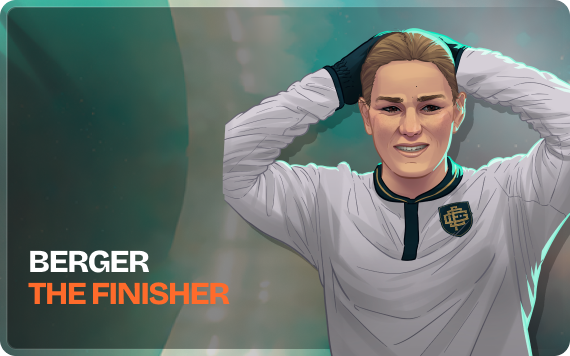
That identity is exactly what we wanted to capture when Berger became a Player Card in One Touch.
Her card begins with 8 ATK, no defensive contribution and a relatively short time cost of 4. On the surface, the message is already clear: Berger is not a player you send onto the pitch to stabilise a match. She is there to attack it. But the most important part of the card appears after she has been on the field for two turns. At that point, Berger loses 5 ATK, dramatically reducing the offensive threat that made her so dangerous when she first arrived.
That weakness is deliberate.
In football, some players control matches through longevity. Others become more influential as the game develops. Berger belongs to another category entirely. She is the player a coach looks towards when a match has reached that strange moment where one run, one mistake or one perfectly timed substitution can change everything. She enters with fresh legs against defenders who have already spent an hour tracking movement, and suddenly every metre becomes dangerous. The question is not whether Berger can stay effective forever. The question is whether you can exploit the window in which she can decide the match.
There is something of the great impact substitutions in football in the way her card works. The kind of player introduced late in a major game with one very clear mission, who does not need twenty chances because the entire match might be decided by the first one. Football history is filled with players who entered enormous matches from the bench and changed them with a single movement, a single finish or a single moment of clarity. Berger’s gameplay is built around exactly that tension. You know her greatest strength will not last. Your opponent knows it too. What neither of you knows is whether two turns will be enough.
With Berger, timing is part of the card.
Gold Doesn’t Always Win Matches
Berger also represents something important about the way we think about cards in One Touch. In a football card game, it would be very easy to make rarity synonymous with superiority. Gold beats Silver, Silver beats Bronze, and eventually every player simply tries to fill a deck with the rarest cards available. That may make collecting easy to understand, but it does not make strategy particularly interesting.
Football has never worked like that.
The greatest teams are not simply collections of the eleven most famous players available. They are built around roles, timing, complementarity and the ability of different profiles to solve different problems. A substitute can be more valuable in the 75th minute than a superstar who has been on the pitch since kick-off. A player with one exceptional quality can be more useful in a particular match than someone who is slightly better at everything. Coaches do not only ask who their best players are. They ask which players they need.
Berger is a Silver card, and that matters. She is not supposed to dominate every situation or remain the obvious choice throughout an entire match. Her 8 ATK gives her enormous immediate offensive potential, but her decline after two turns forces the player to understand exactly what she is for. Play her without a plan and much of her value disappears. Find the right moment and suddenly a Silver card can become the most important card in your hand.
That is the kind of decision we want deckbuilding in One Touch to create. Not simply which card is stronger?, but which card is right, right now?
The Kind of Career We Stop Noticing
There is a strange injustice in being consistently excellent. Football naturally gravitates towards novelty. We talk about the teenage prospect arriving for the first time, the record transfer changing clubs or the player suddenly producing the season of a lifetime. Consistency is less dramatic. When someone performs at an extraordinary level for long enough, excellence gradually becomes normal, and normal things rarely make headlines.
That is perhaps why Berger’s career deserves to be looked at as a whole. The goals matter, of course. So do the trophies, the international appearances and the years spent competing at the highest level of German and European football. But the real achievement lies in how long she has made all of it look ordinary. Different teammates, different opponents, different coaches, different tournaments, and still the same movement towards the near post. The same glance over the shoulder. The same two steps into space. The same finish.
At 30, Berger does not need to convince anyone anymore. She has already spent a career answering every question a striker can be asked. Can she score at the highest level? Can she do it consistently? Can she do it for Germany? Can she perform when the matches become bigger, the spaces become smaller and the defenders become better? Eventually, when the answer remains the same for long enough, people stop asking.
That is where Berger is now.
Not the new name everyone is discovering.
Not the player demanding your attention.
Just the striker defenders still cannot afford to forget.
Because Berger does not need an entire match.
Sometimes, two turns are enough.
Download the app
Download the app




Latest news
.webp)



.svg)