Why the Best Players Don’t Always Make the Best Team

.webp)

.webp)
.webp)
There is a wonderfully simple way to build the greatest football team in the world. Take the best goalkeeper you can find, place the two best centre-backs in front of him, add the most dominant midfielders, choose the most creative wingers, finish with the greatest striker available and send everyone onto the pitch. On paper, it should be almost unfair. Eleven exceptional footballers, eleven players capable of deciding matches individually, eleven names that would make any supporter dream when reading the starting line-up. Football, however, has spent more than a century reminding us that things rarely work that way.
The history of the game is filled with teams that appeared unbeatable before the first whistle and strangely ordinary once the ball started moving. Incredible attacking players occupy the same spaces, midfielders all want the ball at their feet, full-backs attack simultaneously, nobody wants to perform the invisible work and suddenly a collection of brilliant individuals begins looking less like a team and more like eleven separate ideas sharing the same shirt. On the opposite side of the pitch, a supposedly less talented group moves together, understands exactly what each player is expected to do and somehow makes football look much simpler. The difference is not necessarily talent. Sometimes, it is simply that one side has eleven great players while the other has a great team.
Football Has Never Been About Eleven Superstars
We naturally talk about football through individuals because individuals are easier to remember. Goals have scorers, assists have creators, trophies have captains and the biggest moments eventually become attached to the players who produced them. When we look back at a great team years later, our memory tends to preserve its stars first. Yet watch those teams again and something else quickly becomes apparent: almost every legendary side contained players whose importance was much greater than their fame.
There was the midfielder who rarely appeared on the scoresheet but always seemed to be available when possession needed somewhere to go. The defender who understood when his attacking full-back needed protection and quietly moved across before the danger existed. The forward who sacrificed the positions from which he could score because his movement created space for someone even more dangerous. These players were not weaker pieces tolerated alongside the stars. They were often the reason the stars were able to become stars in the first place.
This is one of football’s most beautiful contradictions. A player can become more valuable by accepting that he does not need to be the most important player on the pitch. A team can become more dangerous by adding someone who scores fewer goals. A coach can improve an attack by choosing a footballer whose greatest contribution is creating space for somebody else. Football constantly reminds us that individual quality and collective value are related, but they are not the same thing.
Every Team Needs Someone to Do the Work
Imagine a midfield containing three extraordinary playmakers. Each can control a match, break defensive lines and create chances from almost nothing. Individually, they are magnificent. Put them together, however, and the first question a coach asks is not what they can do with the ball. It is what happens when they lose it. Who protects the defence? Who follows the runner? Who wins the second ball? Who occupies the position that allows the others to leave theirs?
This is where squad building becomes something much more interesting than ranking footballers from best to worst. A coach is not assembling a list of talent; a coach is solving a puzzle in which every piece changes the value of the pieces around it. Sometimes the solution is another world-class player. Sometimes it is the tireless midfielder who understands exactly where to stand. Sometimes it is the experienced defender who communicates constantly. Sometimes it is a substitute who may only play twenty minutes but whose speed becomes devastating precisely because the opponent has already played seventy.
None of these decisions makes much sense if football is viewed purely through individual ratings. They make perfect sense when football is understood through roles.
That distinction is fundamental because the question is no longer “Who is the better player?” It becomes “Who does this team need?”
The Best Coaches Build Relationships, Not Collections
This is also why great squad building often looks surprisingly conservative from the outside. Supporters see an exciting new signing and immediately imagine another superstar arriving beside him, while coaches frequently seem more interested in finding balance. They think about relationships between positions, profiles that complement each other and the consequences one player’s freedom will have for everyone around him. If a winger stays high, somebody must cover the space behind him. If a number ten is given complete creative freedom, somebody else must provide structure. If both full-backs attack, the midfield needs to understand how the team will defend the transition.
A tactical system is ultimately a network of compromises. Giving one player more freedom usually means asking another for more discipline. Adding creativity somewhere may require adding security somewhere else. Even the most attacking football teams need players whose first instinct is to protect what happens when the attack fails. The objective is therefore never to maximise every individual quality simultaneously. It is to create an environment in which the qualities that matter can express themselves without destroying the balance of everything around them.
This is why some footballers seem transformed after changing teams. Their technical ability did not suddenly improve overnight. Their pace did not increase because they changed shirts. They simply entered a system that understood what they were good at and surrounded them with players who allowed them to do it more often. Football did not change the player. The relationships around the player changed his value.
A Gold Card Is Not Always the Right Card
When we began translating football into a competitive card game, this was one of the ideas we absolutely wanted to preserve. Card games naturally encourage players to think about power. A card has better statistics, greater rarity or a more impressive effect, so the immediate assumption is that it must also be the better choice. Fill a deck with enough powerful cards and, logically, you should have built the strongest possible deck.
But that would not feel much like football.
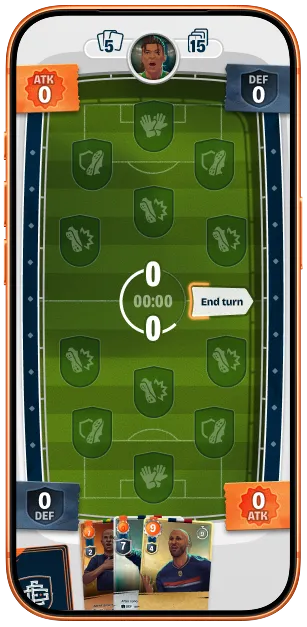
In One Touch, Gold, Silver and Bronze cards are not supposed to represent a simple ladder where every Gold card automatically replaces every Silver card below it. Rarity matters, of course, and powerful cards should feel powerful, but deckbuilding becomes interesting only when the relationship between cards matters as much as their individual strength. A Silver card played in exactly the right situation can be more valuable than a Gold card with impressive statistics but no real place in your strategy. A Bronze card that completes a combination, protects an important player or gives your deck something it otherwise lacks can become one of the reasons the entire system works.
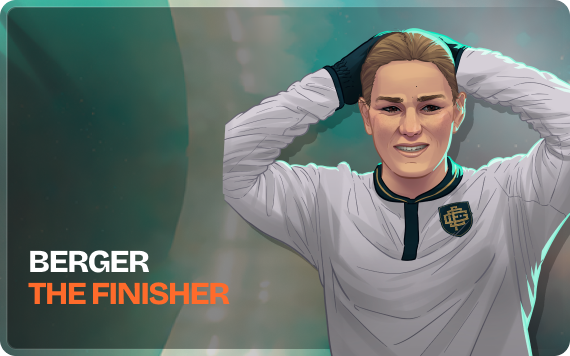
Berger is a good example. Her Silver Player Card arrives with 8 ATK, making her immediately dangerous, but after two turns on the field she loses 5 ATK. Look at the card only through raw power and the weakness is obvious. Understand the role, however, and the card begins telling a completely different story. Berger is not supposed to control an entire match. She is a penalty-box predator built to enter at the right moment, attack tired defenders and create an immediate offensive threat. Her value does not come from being permanently strong. It comes from understanding exactly when you need what she offers.
That is football translated into deckbuilding.
Sometimes the “Weaker” Player Makes the Team Stronger
There is an instinct in competitive games to optimise everything. Players quickly identify the cards with the best numbers, compare efficiencies and eventually discover what appears to be the mathematically correct way to build. That process is part of the pleasure of a TCG or card game, and One Touch is no different. We want players to analyse cards, debate their value and discover combinations that we may not have anticipated ourselves. But we also want the game to keep asking a more difficult question than simply which card has the highest number.
What happens around it?
Perhaps your strongest Player Card consumes too much match time for the strategy you are trying to build. Perhaps another card has lower statistics but creates a relationship with the rest of your squad that makes several other Players stronger. Perhaps your opponent has built specifically to counter the Gold card everyone is currently using, while an overlooked Bronze option creates exactly the problem their deck cannot solve. Suddenly rarity stops being an answer and becomes only one piece of information among many.
Football supporters understand this instinctively because we have watched it happen for generations. The player with the biggest reputation is not automatically the right signing. The most expensive squad does not automatically become the best team. The substitute is not necessarily less important because he starts on the bench. Context changes value, and football is a sport built almost entirely around context.
A great coach knows that.
A great deckbuilder should know it too.
Build a Team, Not a Collection of Names
Perhaps this is ultimately what makes squad building so fascinating. There is no definitive eleven that works against every opponent, just as there should never be one perfect deck capable of answering every situation. Football changes according to the score, the opponent, the competition, the physical condition of the players and even the moment within the match. What was the right solution twenty minutes ago can suddenly become completely wrong. The ability to build a team therefore matters, but so does understanding when and why that team works.
This is the philosophy we want behind deckbuilding in One Touch. Opening a collection and finding a Gold card should be exciting. Building a squad around powerful Players should feel rewarding. But the moment we make every lower-rarity card irrelevant, we lose something fundamental about both card games and football. Bronze needs a purpose. Silver needs a purpose. Gold needs a purpose. The interesting decision begins when all three can be the correct answer for different reasons.
Because the best football teams have never been built by asking which eleven players would have the highest individual ratings.
They are built by understanding space, personality, timing, sacrifice, chemistry and roles. They are built by recognising that sometimes the player who touches the ball least creates the space that decides the match, that sometimes the substitute becomes the hero, and that sometimes the least glamorous name on the team sheet is the first one the coach would refuse to remove.
Football has never been about collecting the best players.
It has always been about finding the right ones.
Download the app
Download the app


Latest news
.webp)


.svg)