Football Is a Game of Decisions

.webp)

.webp)
.webp)
There is a moment that every football supporter experiences, although very few people notice when it happens.
As children, we all watch football in exactly the same way. Our eyes follow the ball from one end of the pitch to the other. Every pass attracts our attention, every dribble makes us jump from the sofa and every shot feels like the only thing that truly matters. The match is reduced to a single object moving across the grass, and everything else becomes background noise. It is a simple way of watching football, but it is also the most natural one. After all, the ball is where the action happens… or at least, that’s what we believe.
Then, almost without realising it, something changes.
It might happen after years of playing yourself, after listening to a coach explain a tactical choice, after watching the same match twice, or simply because you have seen enough football to begin recognising patterns that once felt invisible. Your eyes slowly stop following the ball all the time. Instead, they drift towards a striker making a run that nobody rewards. They notice a defender taking two quiet steps forward to compress the space behind the midfield. They linger on a goalkeeper shouting instructions before the danger has even appeared. Suddenly, you are no longer watching what is happening. You are watching what is about to happen.
That is the day football becomes a completely different sport.
One of the greatest misconceptions about football is that goals are created by moments of genius. We remember the volley, the dribble, the impossible save or the spectacular finish because they are the images replayed endlessly on television and social media. They become the story we tell after the match, the highlights we send to friends and the clips that live forever online. Yet those moments are almost never the real beginning of the action.
A goal is usually born much earlier. It starts with a movement that barely anyone notices. A striker drifts between two defenders, not because he expects the ball, but because he wants to pull one of them out of position. A midfielder recognises the space that suddenly appears and changes the angle of his next pass. A winger delays his run by a fraction of a second to avoid the offside trap. The goalkeeper adjusts his position long before the shot is taken, forcing the striker towards a less comfortable finish. None of these decisions will appear on the scoresheet. Some of them will never even be mentioned by the commentators. And yet, without them, the goal simply never exists.
That is what makes football such a fascinating game. The most important actions are often invisible.
This is also why the greatest players rarely impress their coaches for the same reasons they impress the crowd. Supporters celebrate the spectacular because it is easy to see. Coaches celebrate anticipation because it is much harder to teach. Every football fan remembers the striker who scored thirty goals in a season, but ask the manager of that team and he will often spend just as much time talking about the midfielder who always knew where the second ball would land, or the centre-back who seemed to intercept passes without ever diving into a tackle.
Football intelligence is one of the strangest forms of intelligence in sport because it rarely announces itself. It hides in positioning, timing, patience and restraint. It is the ability to recognise the right decision before anyone else has even realised there is a decision to make. That is why some players always appear to have more time than everyone else. In reality, they do not play faster. They simply think earlier.
The more we watched football, the more this invisible side of the game fascinated us. We found ourselves discussing movements that never appeared in highlight videos, debating substitutions before they happened and trying to understand why one coach saw opportunities where another only saw danger. Matches became less about individual moments and more about the thousands of tiny choices that slowly shaped ninety minutes. The ball was still important, of course, but it no longer felt like the centre of the game. It had become the consequence of something much larger.
Without really planning it, we had started watching football like coaches.
And once you begin seeing the game that way, it becomes impossible to ignore how much of football is actually built on decisions rather than execution.
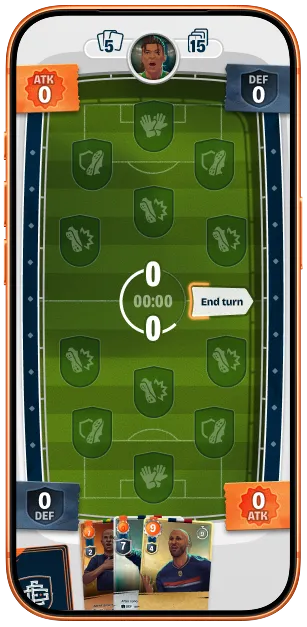
When we eventually started imagining One Touch, we didn’t begin by asking ourselves how to recreate dribbling, shooting or passing. Those mechanics already exist in countless football games, and many of them do an incredible job of reproducing the speed and intensity of a real match. We wanted to explore a different question, one that had followed us for years every time we watched football from the stands or in front of a television.
How could a game reward the same qualities that great football rewards?
How could anticipation become more valuable than reflexes? How could patience become stronger than constant action? How could reading your opponent feel just as satisfying as beating him with pace? Those questions slowly became the foundation of One Touch. Every mechanic, every card and every tactical choice was designed around the idea that football is not simply a game of execution. It is a game of judgement.
That is probably why football and trading card games have always felt closer than people imagine. At first glance, they seem to belong to completely different worlds. One is played on grass with twenty-two players. The other takes place around a table or on a mobile screen with decks of carefully selected cards. Yet the emotions they create are remarkably similar. Both reward preparation over improvisation. Both ask players to think several moves ahead. Both encourage adaptation rather than repetition. Above all, both remind us that making the right decision is often more powerful than having the strongest individual piece.
The best deck is rarely the one filled with the rarest cards.
The best football team is rarely the one filled with the biggest stars.
In both cases, success comes from understanding how every element works together.
That is the football we wanted to celebrate.
Not just the spectacular goals that dominate highlight reels, but the countless invisible moments that make those goals possible. The conversations between defenders before a corner. The winger who stretches a defensive line without touching the ball. The midfielder who deliberately slows the tempo because he recognises that the match needs to breathe before it can accelerate again. Those moments rarely make the front page of a newspaper, yet they are the reason football continues to fascinate millions of people every weekend.
One Touch was never designed to replace football or imitate it perfectly. It was designed to shine a light on the part of football that often goes unnoticed. The hidden game behind the visible one. The chain of decisions that quietly shapes every match long before the final whistle.
Because the longer you love football, the less you watch the ball.
And perhaps that is when you truly begin to understand the game.
Download the app
Download the app


Latest news
.webp)

.svg)